Friday, April 1, 2011

Letter from the President

Marketing has been on my mind lately. I've been running some numbers for my business and realizing it's time to shake off the winter doldrums and bump things up a bit. Marketing is a word I dislike, because I do not want to "market" my work, I just want the world to see how beautiful my pottery is and buy it without me having to shill. I think it's not unusual for artists to have an aversion to marketing because of its connotations and connection to the "marketplace" when we would rather float above the dirty business of commerce and focus on creating works of art. But let's get real: unless you plan to give away all of your work -- or store it in a massive warehouse for eternity-- if you are making art, you probably want to sell it if for no other reason than to get it out of your studio so you can make more. If you want to sell, you have to think about marketing. But how can we, as artists, pursue marketing in a way that makes us feel like it is reflecting our work, our values, and our creativity?

One of the things to think about is developing your "story" as an artist. It's the story of who you are and what your work represents in the world. I think we are all aware that traditional advertising and marketing is no longer what hooks us anymore, it's too boring, it doesn't stand out. What stands out is the personal, the authentic, the tale of how things came to be. This is the real meat of what interests buyers, what makes them want to make that move to spending actual money on a piece of your work. Your story is speaking to them and they want that tale told, over and over again, in the form of your artwork in their home.

Telling your story is an art in itself, and takes time, work, and refinement to get it just right. Have you thought about what your story is? Have you put it down an paper and read it over to see if it is a compelling story that really tells your customers about you? I'm sure most of us need a little help in this department, so I've posted some handy links to get you started and motivated:

Many of these posts have more helpful links, so put aside a few hours for some reading, writing and inspiration, and tell us your story!

Monday, February 28, 2011

letter from the president: facebook

I don't mean to put you on the spot, but do you like us? I mean really really "like" us? The quotation marks might be a tip off to some of you that I'm referring to the "like" feature on Facebook. Did you know the ACGA has a Facebook fan page? Not many do, because the last time I checked, we only had 133 fans. For an organization with over 500 members, so few fans tells me we have some work to do on the fan page.

If you have a Facebook profile already, please look us up at facebook.com/ClayandGlass and hit that "like" button! Once you "like" us, you can post on the ACGA wall, and I invite you to do so. What's appropriate for the ACGA fan page? Basically, anything related to clay and glass, especially the activities of our members. Are you having an open studio or have you recently updated your website? Post it to the wall. Any clay or glass related links you find interesting including exhibit opportunities, technique articles, or artist profiles can easily be shared with others by posting it to the wall. If you have some new work you are excited about, upload the images to our wall and invite comments!

Do you have a facebook page? If you do, please "like" us right away, and then invite all of your friends to like us!

Friday, January 28, 2011

letter from the president

Happy New Year to all of our members! A fresh years means some new people on our Board of Directors. We have three new Board Members to welcome, Forrest Lesch Middelton, Guangzhen "Po" Zhou, and Jean Cherie. I am always gratified to have new people on the Board, and I hope these three are as excited as I am to have them contributing to the running of our organization.

If you missed our annual ACGA retreat on February 9, there were many topics discussed concerning the future of our organization. As president, my primary interest in the ACGA is making it a viable, supportive organization for clay and glass artists practicing their craft, now and in the future. The ACGA can only do all that it does by ensuring a dependable flow of revenue that helps to support our activities. We have several revenue sources, the primary ones being membership dues and the sales from the Palo Alto Clay and Glass Festival. While the PACGF continues to be a successful show in many ways, as seen by the high-quality work shown and continued steady attendance by patrons and fans, the hard fact is we are steadily losing ground in revenue. This is due to rising costs and lower sales gross, a deadly combination. To mitigate some of the losses, the Board voted on a small booth fee hike of $25. I feel strongly that this increase is necessary to alleviate some of the financial pressures of putting on the Festival. We have not increased the booth fee in seven years, and many on the Board felt it was time. We all dislike raising booth fees for any reason, and I want our members to know that we are cutting costs where it is possible to avoid putting more debt burden on our members in the future.

While I am on the subject of the Palo Alto show, I want to mention our publicist, Sharon Poynor, is always looking for fresh angles and stories to help get word to the public about our incredible artists, and you can help her by sending her your stories and ideas for publicity. What new and interesting work will you be bringing? What's special and different about you and your work? Answering these questions and sending your thoughts to Sharon will help her craft the best publicity possible. Even if you are not showing at Palo Alto, any fresh concept or idea for publicity is welcomed by our publicist, so please email her at sharon@poynorpr.com Someone mentioned at the retreat that it is easy to be lazy when it comes to publicity and assume that the ACGA has a handle on it. While we do the best we possibly can to publicize the the Palo Alto show, it is up to all of us as individuals to help contribute to the overall success of the show by communicating with our audience.

Ideas? Comments? Post them here!

Sunday, January 23, 2011

ACGA Clay & Glass Exhibition Opening - January 22, 2011


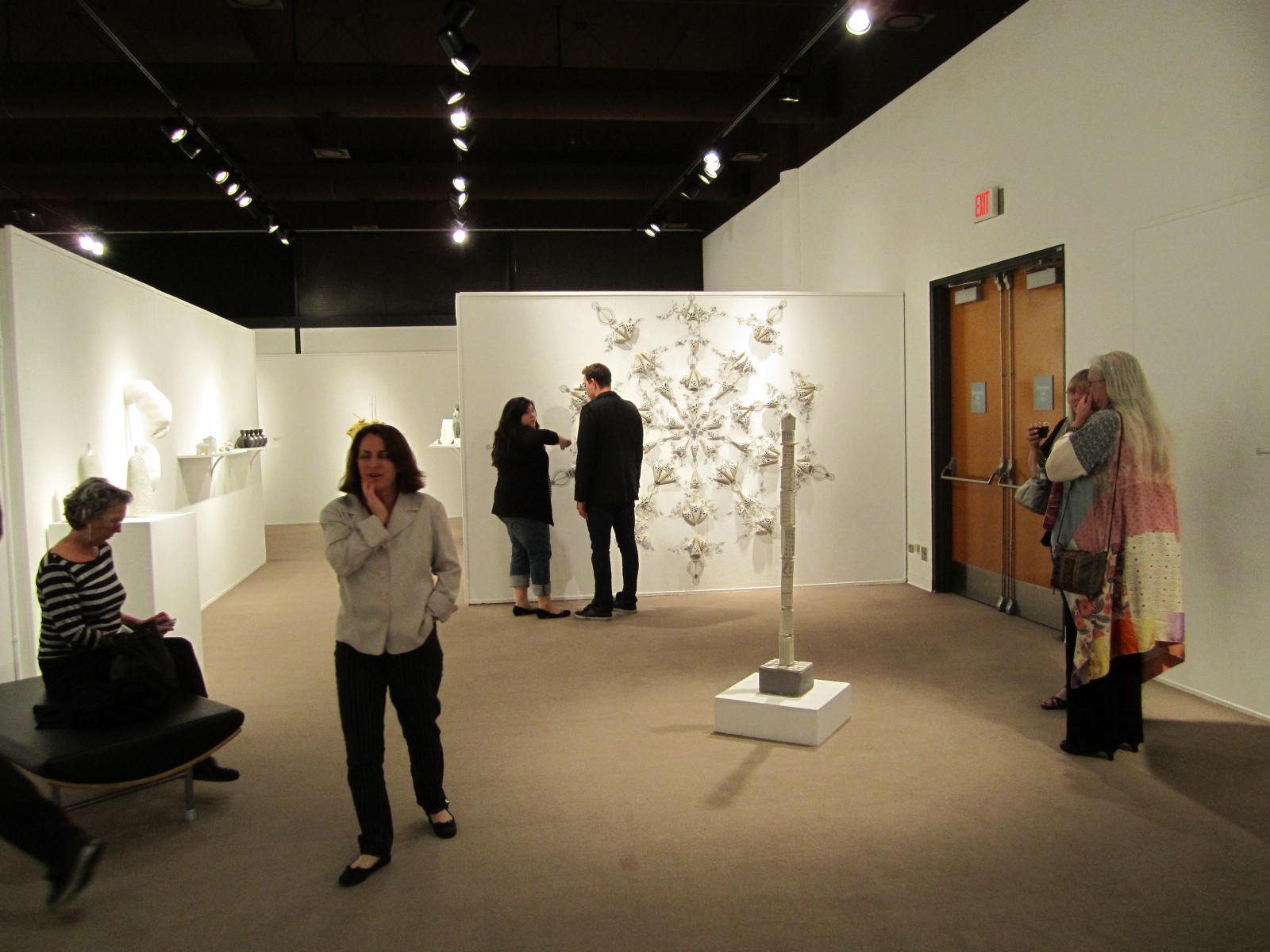
A large crowd of residents, artists and friends attended the opening of the ACGA Clay and Glass National Exhibition at the City of Brea Art Gallery on January 22nd. The gallery director, Christina Hasenberg, as well as the Brea Community Services manager, Emily Keller, commented on how pleased they were with the quality of work on display and the reaction of gallery patrons to it. Many attendees were overheard to say “it’s great to see three dimensional art in the gallery” and “the quality of this work is amazing”.


JURY STATEMENT FOR ACGA
Submitted by Jo Lauria, January 2011

It was both a pleasure and an honor to serve as the juror for the ACGA’s Clay and Glass National Competition. As I was reviewing the work in this competition, I felt that one of my primary judicial duties was to uphold and reaffirm the ACGA’s stated mission: to promote “high standards of craftsmanship and design in clay and glass.” This was the starting point, the bench mark, against which all entries would be evaluated. However, there were several other important factors that contributed to the decision-making process. I’d like to walk you through the “trail of thinking” that resulted in the selection of 81 exceptional objects.
More than 150 artists entered this competition and submitted over 400 works for consideration. Demographically, these artists represent twenty-eight states of the union, with a higher concentration of artists living in California (understandably as the ACGA is California-based). Clay works dominated the submissions, accounting for more than 80% of the entries. This is reflected in the final selection; a walk through the galleries will reveal that there are more works on display made of clay.

Sifting through the 400+ works brought to the surface several prevalent ideas and approaches that artists working in both fields of clay and glass found to be fertile ground. Some of the more engaging concepts and topics included: explorations of ornament and its genesis in the patterns of nature; the sculptural potential of the vessel; the emotive potency of narrative sculptures, whether stylized, abstracted or representational; the unapologetic celebration of Beauty and her twin, the Seductress of virtuosic technique; and investigations of presentation strategies--ranging from works strung on wires, scattered across walls, and perched on pillows and plinths. Overall, it was a feast for the eyes to see all the variations on a theme. As expected, the judging process was challenging as there were more worthy pieces submitted than could be accommodated in the gallery space. Ultimately it was the inventive use and deft handling of materials and techniques, combined with an imaginative approach to subject matter, which brought any one piece into focus.

I hope the selection of objects on exhibit here in the City of Brea Art Gallery—displayed beautifully in this stunning, light-filled space—provokes interest and stimulates discussion about what is current in the discourse on Craft and Makers. I think the artworks selected for the exhibition point to a very promising future for the fields of clay and glass.


The exhibition will be on view through March 4th. City of Brea Art Gallery, One Civic Center Circle, Brea CA, 714-990-7730, Wed. thru Sun., noon to 5 pm, Adults 2.00

Saturday, January 15, 2011

ACGA Clay & Glass Exhibition Opening


Please join ACGA for the opening reception of the ACGA Clay & Glass National Juried Exhibition
Saturday, January 22nd, from 7 to 9 pm.

For this co-sponsored exhibition, ACGA and the City of Brea Art Gallery solicited and juried 400 fine art clay and glass entries from across the United States, selecting the 80 best artworks for the show. The juror, Jo Lauria, is a nationally recognized curator, historian and author specializing in contemporary crafts and decorative arts.


The Brea Art Gallery is located at the corner of Randolph Ave. and Birch St. at the Brea Civic & Cultural Center, Plaza Level. For more information, call 714-990-7730 or send an email to breagallery@cityofbrea.net. Gallery Hours: Wednesday through Sunday: 12-5 p.m. Closed: Monday, Tuesday and Holidays Admission: Adults – $2, Children under 12 – FREE


Tuesday, December 21, 2010

ACGA Clay & Glass National

Kelly Berning, The Proportionist, Ceramic

The ACGA Clay and Glass National will open at the City of Brea Art Gallery January 22, 2011, with a reception from 7 to 9 p.m. Congratulations to all of the artists whose artwork was accepted, and thank you to all who applied. Approximately 400 pieces were entered into the competition and 82 works were selected by the juror, Jo Lauria, to be displayed. The exhibition awards are:


First Place - Kelly Berning, Fallbrook, CA
Second Place - Bill Zarvis, Bethel Park, PA
Third Place - Julia Feld, San Jose, CA
Juror's Award - Gary Marsh, Novato, CA

All of the artists juried into the exhibition are:

Shannon Abac, Steve Allen, Sonia D. Barrios-Roman, Steve Belz, Kelly Berning, Trent Berning, David Bogus, Monica Chapon, A. Blair Clemo, Nan Coffin, Jim Connell, Annette Corcoran, Patrick S. Crabb, Jean Nunez Donegan, Luz Mack-Durini, Virginia Eckinger, Pamela Eisenmann, Gary Erickson, Julia Feld, Mark Goudy, Rowan Harrison, Bill Heiderich, Michael Hermann/Gina Lunn, David Hooker, John W. Hopkins, Stephen Horn, Christina Lynn Johnson, Tasha Kali, Shane M. Keena, Yumi Kiyose, Noriko Kuresumi, Heldegard Linggawidjaja, Mary Alison Lucas, Gary Marsh, Lynne Meade, Peter Meyer, Kate E. Nelson, Kevin Bradford Nierman, Beth Ozarow, Kathy Pallie, Peter Pincus, Tom Post, Barbara Prodaniuk, Charlene Doiron Reinhart, Michelle Rial, Liza Riddle, Gail Ritchie, Audrey Rosulek, Bethany Rusen, Jonnie Russell, Adrian Sandstrom, Carla Sarvis, Yoko Sekino-Bove, Jose Sierra, Amanda Small, Linda Smith, Aimee Sones, Penelope Comfort Starr, Kala Stein, Staria Stine, Wangling C. Stokes, Cheryl Tall, Charles Timm-Ballard, Kent Tool, Adam Waimon, James Wayne, Ian Winsemius, Cheryl Wolff, Fred Yokel, Bill Zarvis


The City of Brea Art Gallery is located at One Civic Center Circle, Brea, California 92821. It is open Wednesday through Sunday, noon to 5 p.m., $2 admission, exhibition closes March 4. Visit http://www.breagallery.com/

Bill Zarvis, Emerging Green, Glass


Julia Feld, The Bridge, Ceramic

Wednesday, December 1, 2010

Letter from the President: The ACGA Jury

Before I became president of the ACGA, I was on the Board of Directors for many years. One of the many persistent, ongoing issues that are brought up from our members and from the Board itself is the jury system. Everybody knows jurying into the ACGA as an exhibiting member is a tough process. Prospective exhibiting members have to haul their work to San Francisco, hang out for a few hours while the jury considers their work, and then drive home late in the evening. It's trying, and nerve-wracking. Most people in any group of candidates do not get in. Many exhibiting ACGA members have had to jury two or three times to get in.

The jury's judgment about work is subjective, but it is not capricious. I've been on the jury several times over the years and I've always been impressed by the seriousness of purpose the jury members bring to the process. The ACGA's mission statement is to establish and maintain high standards of craftsmanship and design in clay and glass, and as the jury considers each person's work, that standard is held first and foremost in each juror's mind. Matters of personal taste are put aside as the work is evaluated. Long discussions ensue when the jury is split. Work is held and examined from different angles. Jurors step back and examine the body as a whole. And then, when everybody has had time to formulate and opinion about the work, there is a vote, and the majority rules.

Even with this careful process, there is no doubt that it is imperfect. Most members of the jury do not feel happy to turn away so many. I know as a former juror that I walk away from the process feeling a bit deflated that it is not perfect, worried that the people who get turned down will not be willing to try again. I think it is always worth a second or third shot, even more if it is important to you. But I hear from people, and I know that there are people out there who are not willing to go through the process again. I often wonder of there is a more perfect way to jury work, of making sure that people do not fall through the cracks.

I like to hear about people's experiences with the jury, whether good or bad. Members, both associate and exhibiting, should know that the jury process has been refined over the years and changes made in response to feedback. There are certain things that cannot change, we cannot lower the standard. But there are always tweaks that can be made, ways to make the jury process more perfect. What are your ideas?

Whitney